📚 Understanding Population Growth Models for NEET 2026
As the NEET 2026 examination approaches, understanding key concepts in biology becomes crucial. One vital area that students often explore is population growth models. In this guide, we will delve into the differences between logistic and exponential growth, investigate the factors affecting natality and mortality, and learn how to interpret age pyramids.
💡 Quick Tip: Familiarize yourself with graphs of population growth to answer questions correctly in NEET 2026.
📊 What Are Population Growth Models?
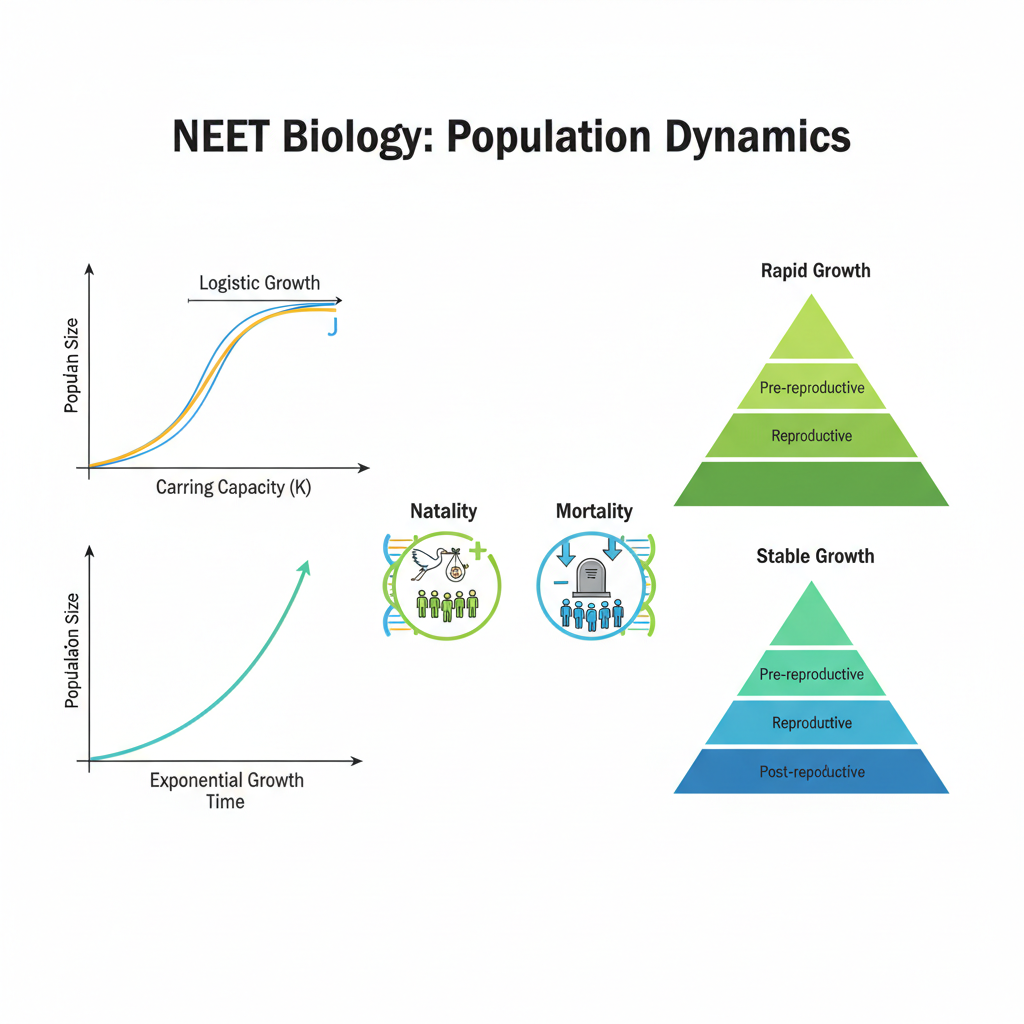
Population growth models provide theoretical frameworks for understanding how populations change over time. They help biologists predict changes in population size under varying environmental conditions. The two primary models include:
- ✅ Exponential Growth: Represents populations that grow without any resource limitation, characterized by a J-shaped curve.
- 🎯 Logistic Growth: Accounts for environmental resistance and resource limitations, forming an S-shaped curve.
🔥 Exponential Growth Model
The exponential growth model assumes that resources are unlimited, leading to a constant rate of growth. This model is frequently seen in populations such as bacteria and invasive species when first introduced to a new environment.
The formula for exponential growth is:
N(t) = N0 * e^{rt}
Where:
- N(t) = the population size at time t
- N0 = the initial population size
- r = the growth rate
- e = base of the natural logarithm
🌿 Logistic Growth Model
Unlike the exponential model, the logistic growth model accounts for environmental limits on population growth. As the population size increases, resources become scarce, leading to a slowdown in growth. The logistic growth can be represented by the equation:
N(t) = K / (1 + ((K - N0) / N0) * e^{-rt})
In this equation:
- K = carrying capacity (the maximum population size that the environment can sustain)
- r = growth rate
✅ Key Takeaways
- Exponential growth is characteristic of populations with unlimited resources.
- Logistic growth models are more realistic for long-term population studies.
- Understanding these models is key for NEET biology questions.
🎯 Natality and Mortality Rates
🔍 What is Natality?
Natality refers to the rate of birth in a population over a specified time period. It significantly impacts population dynamics and can be influenced by factors such as:
- ✅ Environmental conditions (food availability, habitat stability)
- 🎯 Reproductive strategies (r-selection vs. K-selection)
- 📈 Age structure of the population
⚠️ Important: Mortality Rates
Mortality refers to the rate of deaths in a population. Factors affecting mortality include:
- ✅ Disease prevalence
- 🎯 Predation levels
- 🚧 Food scarcity
The balance between natality and mortality rates determines the overall changes in population size.
🌍 Age Pyramids: Visualizing Population Structure
Age pyramids are graphical representations of the age structure within a population. They provide insights into potential growth trends:
- ✅ Expanding populations: Have a broad base, indicating high birth rates.
- 🎯 Stable populations: Exhibit a more rectangular shape, signifying low birth and death rates.
- 🎢 Declining populations: Display narrower bases, reflecting higher mortality or reduced natality.
70%
of students strengthen understanding with diagrams.
📝 Practice Questions for NEET 2026
To excel in NEET 2026, practice is key. Here are some sample questions to help enhance your understanding of population growth:
- 1Define exponential growth and provide a real-world example.
- Answer in context with specific organisms.
- 2How does age distribution in a population influence its growth rate?
- Discuss the implications of age pyramids.
🔚 Conclusion
Understanding population growth models, natality, mortality, and age pyramids is essential for doing well in NEET 2026. By grasping these concepts, you can approach questions with confidence and clarity.
🚀 Ready to Ace Your Exams?
Join thousands of students using TC2R method. Start your free practice test today!