🌱 Respiratory Processes in Plants: An Overview
Understanding the intricate processes of plant respiration is crucial for students preparing for biology examinations in 2026. The terms glycolysis, Krebs cycle, and electron transport chain are essential components of this topic and play a significant role in how plants convert nutrients into energy. In this guide, we will cover how plants respire, the stages involved, and their significance in the ecosystem.
💡 Quick Tip: Mastering the key terms and processes behind plant respiration can enhance your understanding and application in exam scenarios.
🧬 What is Respiration in Plants?
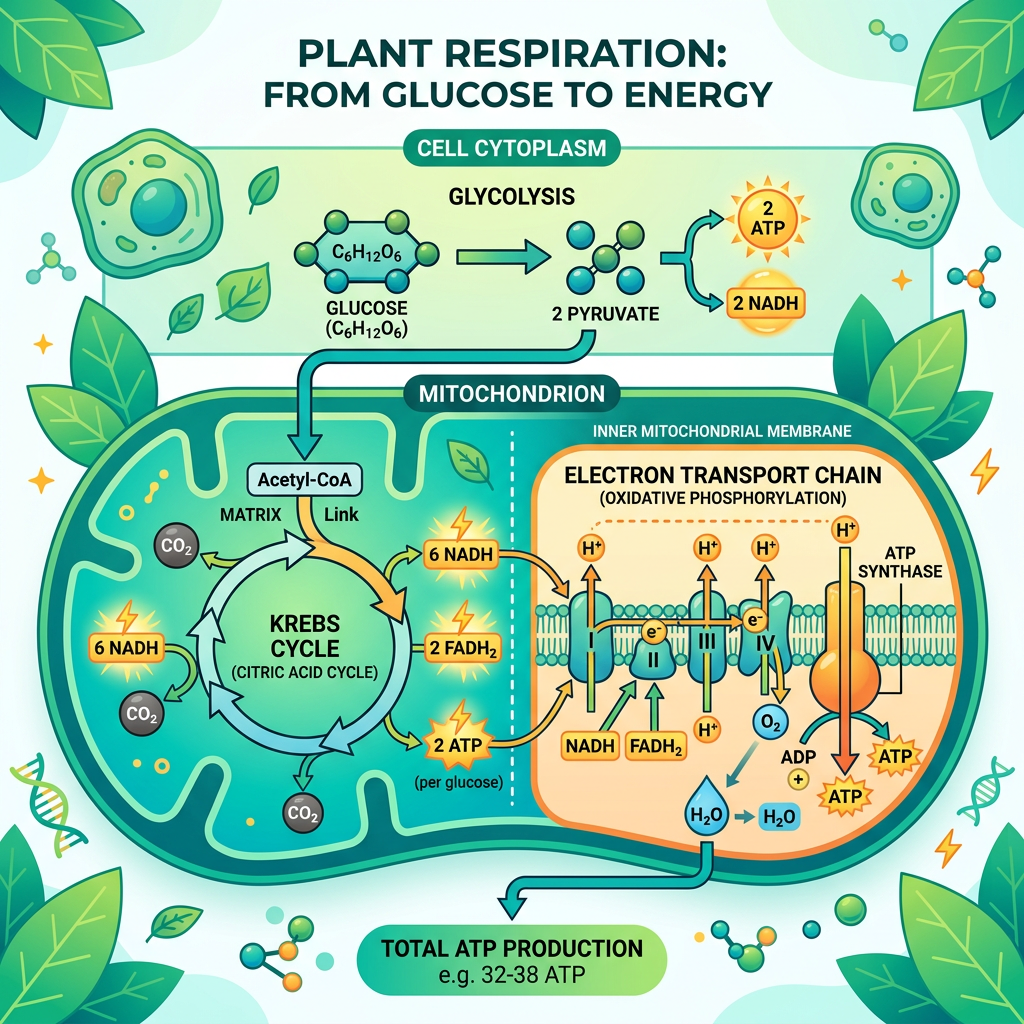
Respiration is a biochemical process by which living organisms convert carbohydrates, fats, and proteins into energy. In plants, this process occurs primarily in the mitochondria and involves several key stages:
- ✅ Glycolysis: The first step of respiration where glucose is broken down to produce energy.
- 🎯 Krebs Cycle: Also known as the citric acid cycle, it generates electron carriers for the next stage.
- 🔄 Electron Transport Chain: The final metabolic pathway that produces the majority of ATP.
- 💧 Fermentation: An anaerobic process that occurs when oxygen is scarce.
📌 Glycolysis: The Starting Point
Glycolysis is the anaerobic process where glucose, a six-carbon sugar, is converted into two molecules of pyruvate while producing energy in the form of ATP and NADH. This process occurs in the cytosol and comprises ten enzyme-catalyzed reactions. Here are the key steps:
Glucose Phosphorylation
- Glucose is phosphorylated using ATP, forming glucose-6-phosphate.
Cleavage
- The six-carbon compound is split into two three-carbon molecules.
Energy Harvesting
- The three-carbon molecules undergo oxidation, generating ATP and NADH.
🌿 The Krebs Cycle: Second Stage
After glycolysis, the pyruvate molecules enter the mitochondria, where they undergo a series of reactions in the Krebs cycle. This cycle is crucial for generating electron carriers (NADH and FADH2) that are essential for the next step of respiration.
The Krebs cycle can be summarized in a few key reactions:
- ✅ Acetyl-CoA formation: Pyruvate is converted into Acetyl-CoA, gaining a carbon dioxide molecule.
- 🎯 Citric Acid Formation: Acetyl-CoA combines with oxaloacetate to form citric acid.
- 🔄 Energy Carrier Production: Through a series of transformations, NADH and FADH2 are produced, as well as ATP.
✅ Key Takeaways about the Krebs Cycle
- Point 1: The Krebs cycle operates only in the presence of oxygen.
- Point 2: It regenerates oxaloacetate, enabling continuous cycles.
- Point 3: Each turn of the cycle produces valuable energy carriers.
⚡ The Electron Transport Chain: Final Stage
The next phase, the electron transport chain, occurs in the inner mitochondrial membrane. This is where the majority of ATP is produced. The process involves a series of proteins that transfer electrons from NADH and FADH2 to molecular oxygen, creating a proton gradient that drives ATP production through ATP synthase.
- ✅ High Energy Electrons: Electrons from NADH and FADH2 are transferred to the chain.
- 🎯 Proton Gradient Establishment: Protons are pumped out of the mitochondria.
- 🔄 ATP Synthesis: Protons flow back through ATP synthase, producing ATP.
🔍 Understanding Fermentation in Plants
When oxygen is limited, plants can undergo fermentation to generate energy. This process is less efficient than aerobic respiration but essential in anaerobic conditions. Two common types are:
- ✅ Lactic Acid Fermentation: Pyruvate is converted into lactic acid.
- 🎯 Alcoholic Fermentation: Pyruvate is converted to ethanol and carbon dioxide.
⚠️ Important: Fermentation leads to less ATP production, making it a temporary solution for energy deficiency in plants.
📊 The Efficiency of Plant Respiration
36 ATP
produced per glucose molecule via aerobic respiration
2 ATP
produced via fermentation per glucose molecule
"Understanding respiration in plants is foundational for any biology student aiming to excel in their exams."
📋 Conclusion: Your Study Takeaway
Grasping the concepts of respiration in plants, especially glycolysis, the Krebs cycle, and the electron transport chain, equips you with a solid foundation for your biology studies in 2026. Prepare yourself well for your exams by revisiting these topics regularly and practicing related questions.
🚀 Ready to Ace Your Exams?
Join thousands of students using TC2R method. Start your free practice test today!