DNA Replication, Transcription, Translation for NEET 2026💡 DNA Replication, Transcription, Translation for NEET 2026
As NEET 2026 approaches, understanding DNA replication, transcription, translation is crucial for your success. These fundamental biological processes are not just important for the exam but foundational for understanding genetics. Let’s dive deep into what you need to know!
💡 Quick Tip: Focus on understanding the steps of each process and why they are important in the context of human biology and medicine.
📚 Overview of Key Concepts
Before delving into the specifics, it's important to have a roadmap of what DNA replication, transcription, and translation entail:
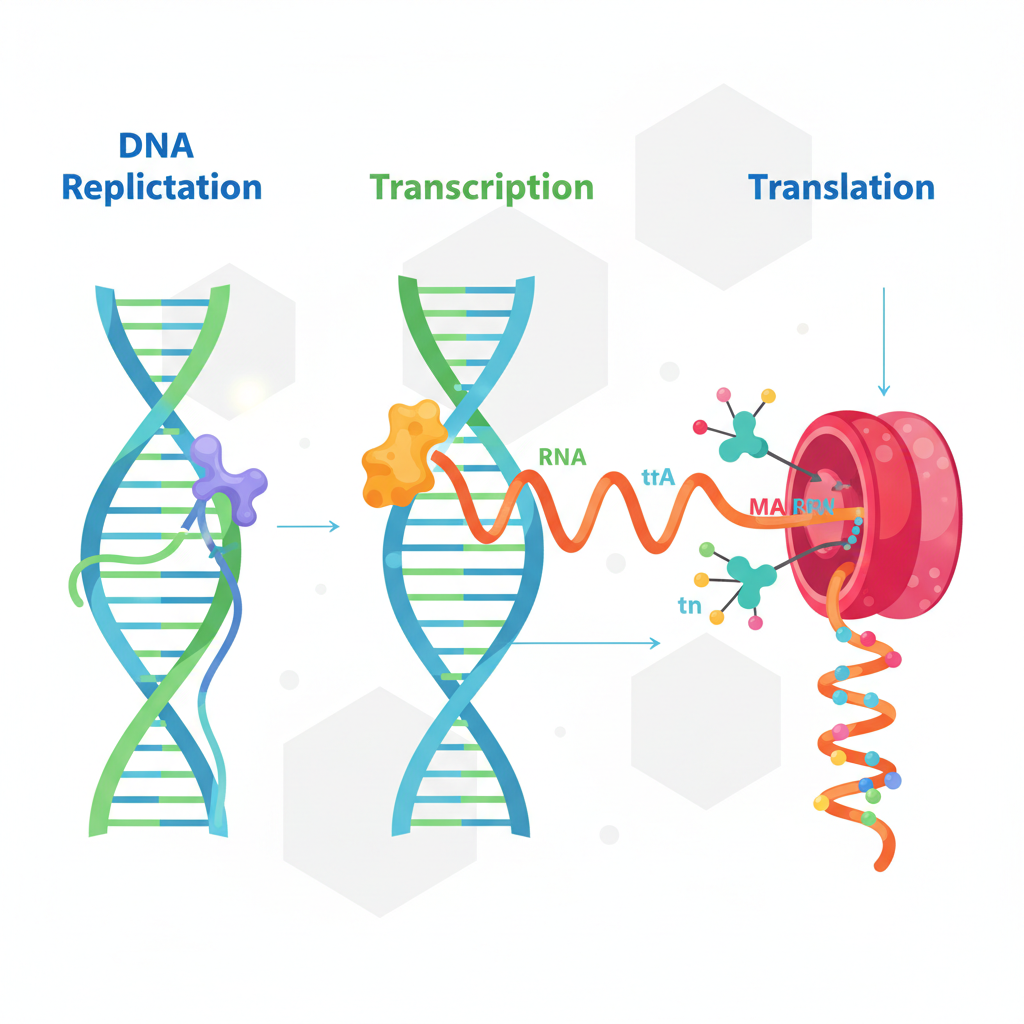
- ✅ DNA Replication: The process by which a cell duplicates its DNA before division.
- 🎯 Transcription: The synthesis of RNA from a DNA template.
- 💾 Translation: The process where ribosomes synthesize proteins using messenger RNA (mRNA).
This knowledge is vital for NEET 2026!🎯 Detailing DNA Replication
DNA replication is a semi-conservative process, meaning that each new double helix consists of one old and one new strand. Here are the main steps involved:
- 1Initiation
- The replication begins at specific locations called 'origins of replication'.
- 2Elongation
- DNA polymerase synthesizes new strands by adding complementary nucleotides.
- 3Termination
- The process happens when the entire molecule has been copied.
⚠️ Important:
Errors during DNA replication can lead to mutations, affecting health and development. Understanding the error-checking mechanisms is key.
📝 Understanding Transcription
Transcription converts DNA into RNA, a critical step in the gene expression pathway. The process can be broken down into:
- 1Promoter Recognition
- RNA polymerase binds to a specific sequence on the DNA, the promoter.
- 2Elongation
- The RNA strand is extended by adding RNA nucleotides complementary to the template strand.
- 3Termination
- Transcription ends when RNA polymerase reaches a terminator sequence.
⚡ Translation and Protein Synthesis
Translation takes place in the ribosomes, where the mRNA is decoded to build a protein. This process involves three main stages:
- 1Initiation
- Ribosome assembles around mRNA and the first tRNA brings a specific amino acid.
- 2Elongation
- As the ribosome moves along the mRNA, tRNAs add their amino acids to the growing chain.
- 3Termination
- The process continues until a stop codon is reached, releasing the finished protein.
✅ Key Takeaways
- Understanding the flow of genetic information: DNA → RNA → Protein.
- Memorize key enzymes involved in each process.
- Practice questions relating to the genetic code and mutations.
📝 Practice and Test Your Knowledge
To solidify your understanding of these concepts and prepare effectively for NEET 2026, consider the following strategies:
- ✅ Engage in active recall by trying to explain processes to peers.
- 🎯 Use diagrams to illustrate complex processes for better retention.
- 💡 Take timed quizzes to simulate exam conditions.
- ⚡ Review past NEET papers focusing on genetics questions.
"Mastering the central dogma of molecular biology is key to acing biology in NEET."
🔥 Conclusion
Understanding DNA replication, transcription, and translation forms the bedrock of genetics and is essential for NEET 2026. **Stay proactive** in your studies, utilize the resources available, and don’t hesitate to reach out for help when you need it! Remember, preparation is the key to success.
🚀 Ready to Ace Your Exams?
Join thousands of students using TC2R method. Start your free practice test today!